
NIXACE TECHNOLOGIES
Azure DevOps certification, officially the AZ-400 exam, which leads to the Microsoft Certified: DevOps Engineer Expert credential, validates your ability to design source control strategies, build and release pipelines, security practices, and monitoring across Azure and GitHub. The real Azure DevOps certification benefits are stronger resume visibility, a structured way to demonstrate DevOps competency, and internal mobility inside organisations that map certifications to pay bands. It is not, on its own, something that gets you hired without pipeline experience to back it up.
Key Takeaways
- There is no separate "Azure DevOps Associate" certification. The DevOps-specific credential is AZ-400, an expert-level exam that requires you already hold AZ-104 (Azure Administrator) or AZ-204 (Azure Developer).
- As of Microsoft's July 2026 update to the exam, over half the exam — 50 to 55% — is weighted toward designing and implementing build and release pipelines. Study time should follow that weighting, not be spread evenly.
- Microsoft explicitly lists GitHub experience as a stated prerequisite skill alongside Azure DevOps. The exam is not Azure-tool-only, which is likely why "certification benefits GitHub" shows up as a related search.
- The biggest real benefits are resume filtering, structured learning, and negotiating leverage during role changes, not automatic job offers.
- Students and career switchers get more value from building 2–3 real pipeline projects before certifying; the certificate then documents skill you already have, rather than substituting for skill you don't.
- A meaningful share of candidates who pass AZ-400 still struggle in interviews when asked to walk through a pipeline design from scratch — a pattern worth taking seriously if your prep has been exam-objective-only.
What the AZ-400 Exam Actually Tests?
According to Microsoft's own exam page, AZ-400 measures your ability across five domains, each carrying different weight toward your score:
Table 1: AZ-400 exam domain weighting
| Domain | Weight |
|---|---|
| Design and implement build and release pipelines | 50–55% |
| Design and implement processes and communications | 10–15% |
| Design and implement a source control strategy | 10–15% |
| Develop a security and compliance plan | 10–15% |
| Implement an instrumentation strategy | 5–10% |
Microsoft also states you need experience "both administering and developing in Azure", with strong skills in at least one, plus experience implementing both GitHub and Azure DevOps solutions. The exam is not scoped to Azure-only tooling.
This weighting matters more than most exam-prep content admits: over half your exam is pipelines. A candidate who studies processes, security, and monitoring evenly but under-prepares on pipeline design is preparing for the wrong exam.
Azure DevOps Fundamentals vs. Associate vs. AZ-400: Ending the Confusion
This is one of the most searched adjacent questions, and it's genuinely confusing because Microsoft's naming isn't intuitive. Here's the actual structure:
Table 2: Azure certification levels relevant to DevOps
| Level | Exam | What It Covers | Prerequisite |
|---|---|---|---|
| Fundamentals | AZ-900 (Azure Fundamentals) | General Azure cloud concepts — not DevOps-specific | None |
| Associate | AZ-104 (Azure Administrator) or AZ-204 (Azure Developer) | Core Azure administration or development skills | AZ-900 is recommended, not required |
| Expert | AZ-400 (leads to DevOps Engineer Expert) | DevOps-specific: pipelines, source control, security, monitoring | AZ-104 or AZ-204 required |
There is no exam called "Azure DevOps Associate". If a course or job posting uses that phrase, it almost always means AZ-400 itself, or a bundle that includes AZ-104/AZ-204 plus AZ-400. Confirm exactly which exam is meant before enrolling in anything using that label.
Exam Logistics: Cost, Format, and Passing Score
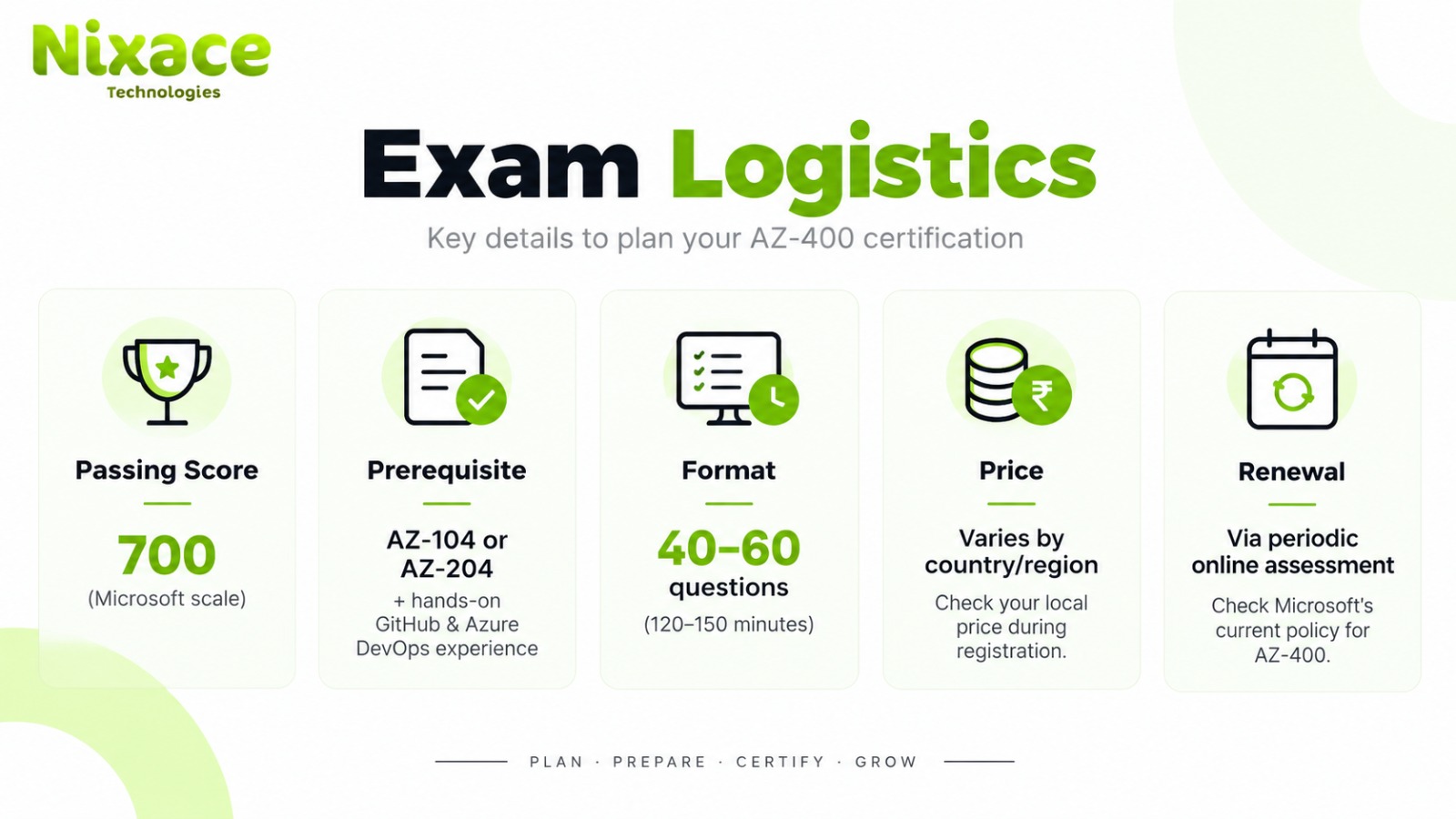
- Passing score: 700, per Microsoft's official scoring scale.
- Prerequisite: AZ-104 or AZ-204, plus hands-on GitHub and Azure DevOps experience.
- Format: Microsoft doesn't publish an exact fixed question count, but independent exam-prep sources consistently estimate 40–60 questions across multiple-choice, case studies, and scenario-based items, typically within a 120–150 minute appointment window. Treat these as informed estimates, not official figures. Verify current format details on Microsoft's own exam page before booking.
- Price: Microsoft's page states pricing is "based on the country or region in which the exam is proctored"; there's no single global figure. Confirm your local price during registration rather than relying on a number quoted elsewhere.
- Renewal: Microsoft's role-based certifications are generally maintained through a periodic online renewal assessment rather than having to retake the full exam. Check Microsoft's current renewal policy page for AZ-400 specifically, since renewal terms are updated from time to time.
The Real Benefits, By Career Stage
Generic "benefits" lists apply to nobody in particular. Here's what actually changes depending on where you are:
If you're a student or fresher
The certification's main value is proving you understand DevOps concepts before you have job experience to prove it another way. Recruiters use it as a filter, not a hiring decision; it gets your resume past automated screening and into a human's hands. Without a portfolio of pipeline projects alongside it, it rarely survives a technical interview on its own.
If you're switching careers into DevOps
This is where certification benefits are strongest. It gives you a structured, verifiable way to demonstrate DevOps competency when your prior job title doesn't say "DevOps engineer". Combined with 2–3 real projects — a CI/CD pipeline you built, an Infrastructure-as-Code deployment, and a monitoring setup — it becomes credible evidence of a genuine transition rather than a resume keyword.
If you're a working professional
Benefits here are about internal mobility and negotiation. It gives HR and managers a documented reason to approve a role change or a raise, especially in organisations where certifications map to pay bands or client-facing credibility — common in IT services companies with Azure partnerships.
Career and Salary Impact in India
Be sceptical of any article quoting a single "average salary" figure for certified professionals with no methodology behind it. Most of these numbers online are drawn from small, self-reported samples on job boards, not verified payroll data. What's more reliably true, based on how Indian IT hiring works:
- Azure DevOps skills sit within the broader cloud and DevOps engineering hiring bracket, which has grown as companies shift more infrastructure to the cloud.
- Certification tends to influence starting offers and internal band placement more than pay growth for someone already several years into a DevOps role, where project experience and system-design ability dominate.
- In Mumbai specifically, IT services firms and mid-size product companies frequently list Azure/AWS certification as "preferred", not mandatory, for DevOps and Cloud Engineer roles; it shortens shortlisting time rather than guaranteeing an offer.
Table 3: Certification value by career stage
| Career Stage | Certification's Main Benefit | What Still Matters More |
|---|---|---|
| Student/Fresher | Resume credibility, concept validation | Hands-on pipeline projects, GitHub portfolio |
| Career Switcher | Proof of intentional transition | Real CI/CD and IaC project experience |
| Working Professional | Internal mobility, negotiation leverage | System design skills, incident response experience |
What the Certification Won't Do
- It will not teach you to debug a failing pipeline under production pressure — that only comes from doing it.
- It will not substitute for hands-on experience with Terraform, Kubernetes, or monitoring tools, which most DevOps job descriptions list alongside Azure DevOps itself.
- It requires periodic renewal; treat it as a maintained credential, not a one-time achievement (confirm current renewal terms on Microsoft's site, since these have changed over time).
- It will not get you hired on its own if you cannot explain, in an interview, how you'd design a pipeline for a real scenario. This is a pattern worth taking seriously, not a scare tactic: certification tests recall and applied judgement on a fixed set of scenarios, while interviews probe open-ended reasoning about a system you've never seen described that specific way before.
Certification vs. Structured Training: What Actually Prepares You
Studying for the exam and building real DevOps competence are related but not identical goals. Exam guides teach you to answer scenario-based questions about Azure DevOps and GitHub features. Structured, project-based training additionally forces you to:
- Set up and break real CI/CD pipelines, not simulated ones
- Work with branching strategies across both Azure Repos and GitHub, since the exam explicitly covers both
- Combine Azure DevOps Pipelines with Infrastructure-as-Code tools (Terraform, ARM/Bicep) end to end
- Get feedback on mistakes before they show up in a job
This is the gap a good offline DevOps training programme is built to close; exam-focused content alone leaves it open.
How to Prepare: A Practical Path?
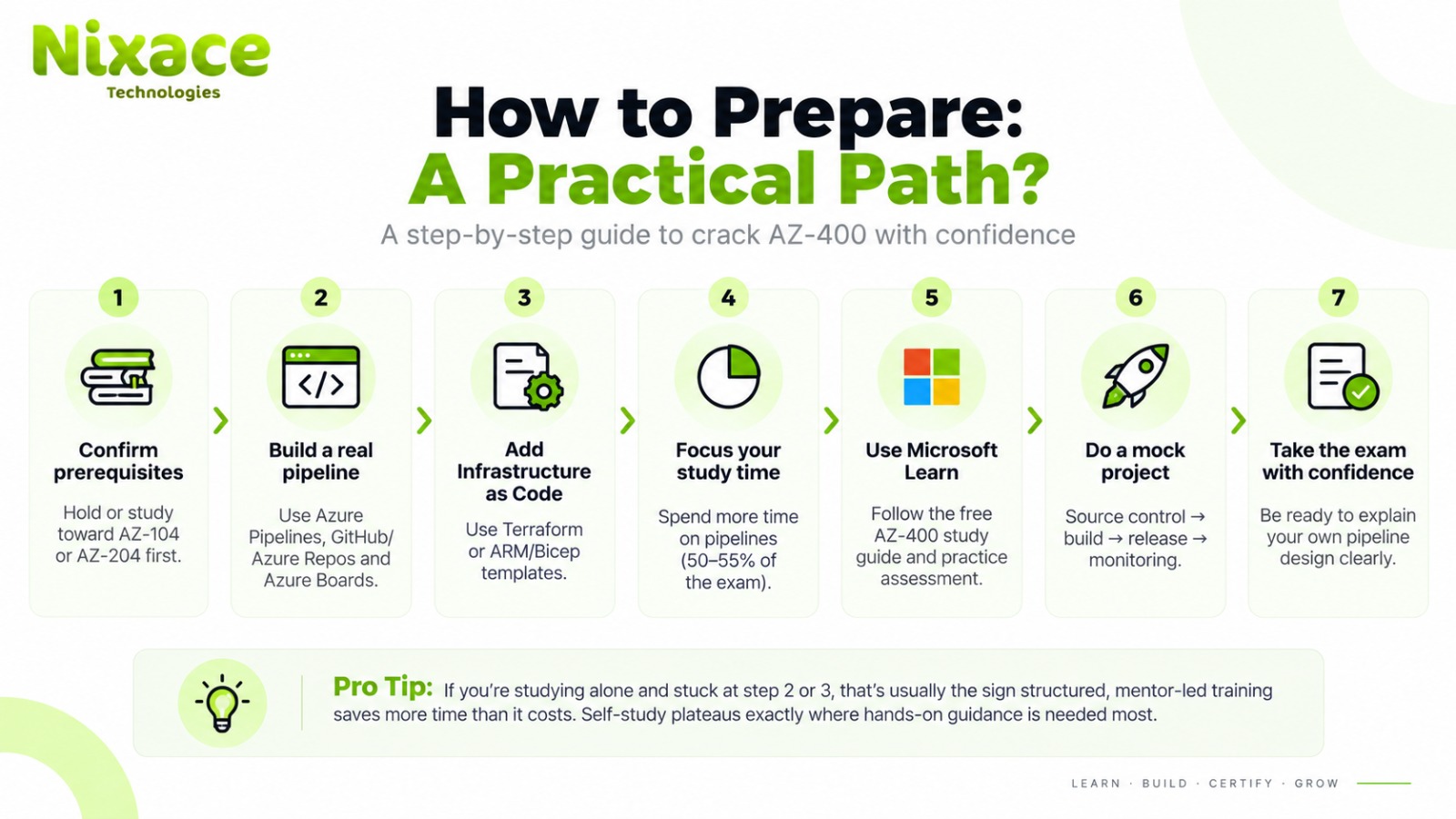
- Confirm prerequisites. Hold or study toward AZ-104 (Azure Administrator) or AZ-204 (Azure Developer) first; AZ-400 assumes this foundation.
- Build one real pipeline before you study for the exam, using Azure Pipelines, Azure Repos or GitHub, and Azure Boards together. Even a simple CI/CD pipeline deploying a sample app teaches you more than a week of slides.
- Layer in Infrastructure as Code with Terraform or ARM/Bicep templates alongside your pipeline. This combination is what most DevOps job descriptions actually ask for, and it's covered under the exam's source-control and pipeline domains.
- Weight your study time to match the exam: since pipelines are 50–55% of the score, spend proportionally more time there than on processes, security, or monitoring.
- Use Microsoft Learn's free AZ-400 study guide and practice assessment to structure exam-specific review once your hands-on base is solid.
- Do a mock project end-to-end — source control → build pipeline → release pipeline → monitoring — closer to what interviewers ask about than exam trivia.
- Take the exam once you can explain your own project's pipeline design out loud, not just recall exam objectives.
Pro Tip: If you're studying alone and stuck at step 2 or 3, that's usually the sign structured, mentor-led training saves more time than it costs. Self-study plateaus exactly where hands-on guidance is needed most.
A Worked Example: What "Design a Release Strategy" Actually Looks Like
To make the largest exam domain concrete: designing a release strategy isn't a single decision; it's a chain of trade-offs. A typical scenario looks like this: a team needs to deploy a web app update several times a week without downtime. The decision path runs: choose a deployment pattern (blue-green vs. canary vs. rolling) based on how much risk the team can tolerate → configure the release pipeline to gate each stage behind automated tests and, for production, a manual approval → decide what triggers a rollback and how fast it needs to happen → instrument the release with monitoring so a bad deployment is caught in minutes, not the next morning.
That single chain touches three of the five exam domains: pipelines, security/compliance (approval gates), and instrumentation, which is exactly why the real exam favours scenario questions over definitions. Building this once, even on a toy project, teaches the decision-making the exam is actually testing far more than memorising what "blue-green deployment" means in isolation.
Common Mistakes Candidates Make
- Attempting AZ-400 with no prior Azure administration or development experience
- Studying all five domains equally instead of weighting toward pipelines (50–55% of the exam)
- Memorising exam dumps instead of understanding pipeline design trade-offs
- Treating the certificate as a finished product rather than a checkpoint in an ongoing skill path
- Skipping Infrastructure as Code entirely, despite it being core to real DevOps roles
- Ignoring the GitHub-related objectives because their training focused only on Azure Repos
Frequently Asked Questions
1. Is Azure DevOps certification worth it in 2026?
It's worth it if you already have foundational Azure experience and pair it with real project work; it strengthens your resume and interview credibility. It's not worth it as a standalone credential with no hands-on backing.
2. What is the Azure DevOps Associate certification?
There is no exam by that name. The DevOps-specific credential is AZ-400, which sits at the expert level and requires AZ-104 or AZ-204 (both associate-level) as a prerequisite. If a course markets an "Azure DevOps Associate" track, confirm exactly which official exam(s) it maps to.
3. What are the prerequisites for Azure DevOps certification?
Microsoft requires holding AZ-104 (Azure Administrator Associate) or AZ-204 (Azure Developer Associate) before attempting AZ-400, plus practical experience implementing both GitHub and Azure DevOps solutions.
4. Does Azure DevOps certification cover GitHub, or only Azure tools?
Both. Microsoft explicitly lists GitHub implementation experience as a prerequisite skill, and the source-control domain covers branching strategies across Azure Repos and GitHub. Preparing with Azure Repos alone leaves a real gap.
5. How is the exam weighted?
Build and release pipelines make up 50–55% of the score, more than the other four domains combined in some scoring ranges. Processes/communications, source control, and security/compliance are each 10–15%, and instrumentation is 5–10%, per Microsoft's official exam page.
6. Does Azure DevOps certification guarantee a job?
No certification guarantees a job. It improves resume visibility and can shorten shortlisting time, but interviews still test practical pipeline, troubleshooting, and system-design ability that the exam only partially simulates.
7. How much can Azure DevOps certification increase my salary?
It typically influences starting offers and internal role or band changes more than salary growth for experienced professionals, where hands-on project depth carries more weight. Treat any specific percentage figure you see online with caution unless it names a verifiable source.
8. What is the difference between Azure DevOps certification and general DevOps skills?
The certification validates knowledge of designing and implementing DevOps practices using Microsoft's tooling and processes. General DevOps skills — CI/CD concepts, infrastructure as code, containerisation, and monitoring — are broader and transferable across cloud providers; strong candidates have both.
9. Can a fresher or student take the Azure DevOps certification directly?
Technically yes, but it's a difficult starting point since AZ-400 assumes associate-level Azure knowledge and hands-on GitHub/Azure DevOps experience. Most students benefit from starting with AZ-104 or AZ-204 plus hands-on projects before attempting AZ-400.
10. How long does it take to prepare for Azure DevOps certification?
This depends heavily on your existing Azure background. Someone with solid AZ-104/AZ-204 knowledge and hands-on pipeline exposure typically needs a shorter, focused review of exam objectives; someone starting from scratch needs to build that foundation first, which takes considerably longer. There's no single verified timeframe that applies to everyone — be wary of sources that state one as fact.
11. Is Azure DevOps certification better than AWS or Kubernetes certifications?
Neither is objectively "better"; it depends on which ecosystem your target companies use. Mumbai's IT services and product companies hire across Azure, AWS, and multi-cloud stacks, so the more useful question is which certification matches the job postings you're actually targeting.
12. Does the certification expire?
Yes, Microsoft role-based certifications require periodic renewal. Confirm the current renewal process and timeline directly on Microsoft's certification page for AZ-400, since these terms are updated from time to time.
Conclusion
Azure DevOps certification benefits are real but conditional: it sharpens your resume, structures your learning around a specific, heavily pipeline-weighted skill set, and gives recruiters and managers a documented reason to move you forward — provided you back it with actual pipeline, Infrastructure-as-Code, and GitHub experience, not just exam-objective recall. Treated as a standalone credential, it does little. Treated as a checkpoint inside a genuine hands-on DevOps learning path, it's genuinely worth pursuing.
If you're in Mumbai and want that hands-on foundation before or alongside certification — real CI/CD pipelines across Azure DevOps and GitHub, Terraform, cloud labs, and mentor feedback rather than slide decks — Nixace Technologies runs offline, project-based DevOps and Cloud training out of Goregaon West, built specifically for students, career switchers, and working professionals making this exact transition.