
NIXACE TECHNOLOGIES
Summary
This guide is for students, IT professionals, and career switchers searching for the best DevOps institute in Mumbai's Western Suburbs. You'll find out why Goregaon West is the ideal base for a DevOps career, what to look for in a training program, what Nixace Technologies covers, and what salary and job outcomes you can realistically expect after completing DevOps training in Mumbai.
1. Introduction: Why Mumbai's Western Suburbs for Your DevOps Career
Every year, thousands of IT professionals and fresh graduates in Mumbai ask the same question: how do I break into DevOps without spending a year on self-study that goes nowhere? The honest answer is that the fastest path combines structured classroom training, real hands-on projects, and a local network of companies actively hiring.
Mumbai's Western Suburbs, stretching from Bandra through Santacruz, Vile Parle, Andheri, Jogeshwari, Goregaon, Malad, Kandivali, and Borivali, are home to some of the city's densest concentrations of IT companies, startups, and MNC development centers. If you are going to invest 4–6 months building a new skill set, it makes sense to study where the jobs actually are.
Nixace Technologies, based in Goregaon West, runs one of the most practically oriented DevOps training programs in this corridor. This guide explains what the program covers, who it is designed for, and what realistic career outcomes are after completing it, without exaggerated claims.
2. What Is DevOps and Why Does It Matter in 2025?
The term "DevOps" gets used loosely, so let's be precise. DevOps is a set of engineering practices that eliminates the traditional wall between software development teams and IT operations teams. In a company without DevOps, developers write code and 'throw it over the wall' to operations engineers, who then deploy it slowly and manually, often with unexpected failures.
DevOps replaces that model with continuous collaboration, automated testing, automated deployment pipelines, and infrastructure managed as code. The result: companies that adopt DevOps practices ship features faster, experience fewer production incidents, and recover from failures more quickly.
Why Companies Cannot Ignore DevOps Any Longer
Indian technology companies from large services firms in the Andheri-Kurla belt to product startups in Goregaon's Mindspace have been adopting DevOps practices at an accelerating pace since 2021. Several factors are driving this:
- Cloud adoption is mainstream. The shift to AWS, Azure, and GCP has moved infrastructure management from physical data centers to API-driven cloud platforms. DevOps engineers are the people who manage this.
- Speed of delivery is a competitive requirement. Companies that deploy twice a day beat those that deploy twice a month. DevOps makes continuous delivery possible.
- Automation reduces costs. Manual deployments, manual testing, and manual infrastructure provisioning are expensive and error-prone. Automation eliminates that category of operational waste.
- SRE and Platform Engineering are growing. Site Reliability Engineering roles are among the highest paid in Indian IT and require exactly the combination of software and operations skills that DevOps training develops.
3. The Western Suburbs Advantage: IT Hubs on Your Doorstep
Location matters more than most training guides admit. When evaluating a DevOps institute in Mumbai, consider not just the classroom but the job market within commuting distance. The Western Suburbs corridor contains several major IT employment clusters:
Table 1: Key IT employment hubs in Mumbai's Western Suburbs
| Area | Major IT Employers / Hubs | Relevance to DevOps |
|---|---|---|
| Andheri East / MIDC | TCS BPS, Cognizant, IBM, Syntel | Large DevOps and cloud transformation teams |
| Goregaon East | Film City Tech Zone, WNS, EXL Service | DevOps roles in data and media engineering |
| Malad – Mindspace | Accenture, Wipro, IBM Technology, Infosys BPM | One of Mumbai's largest IT park clusters |
| Kandivali East | Growing IT services and startup presence | Smaller companies hiring junior DevOps engineers |
| Borivali West | Mid-size IT firms, IT support companies | Entry-level cloud and infrastructure roles |
| Andheri – SEEPZ | Niche product companies, fintech startups | DevOps, SRE, and platform engineering roles |
Studying at a DevOps institute in Goregaon West places you within 15–30 minutes of most of these employment clusters by local train or metro. Your networking opportunities, guest lectures from practitioners, and potential internship placements are all significantly easier to access when the institute is embedded in the right geography.
4. Who Should Join a DevOps Course in Mumbai?
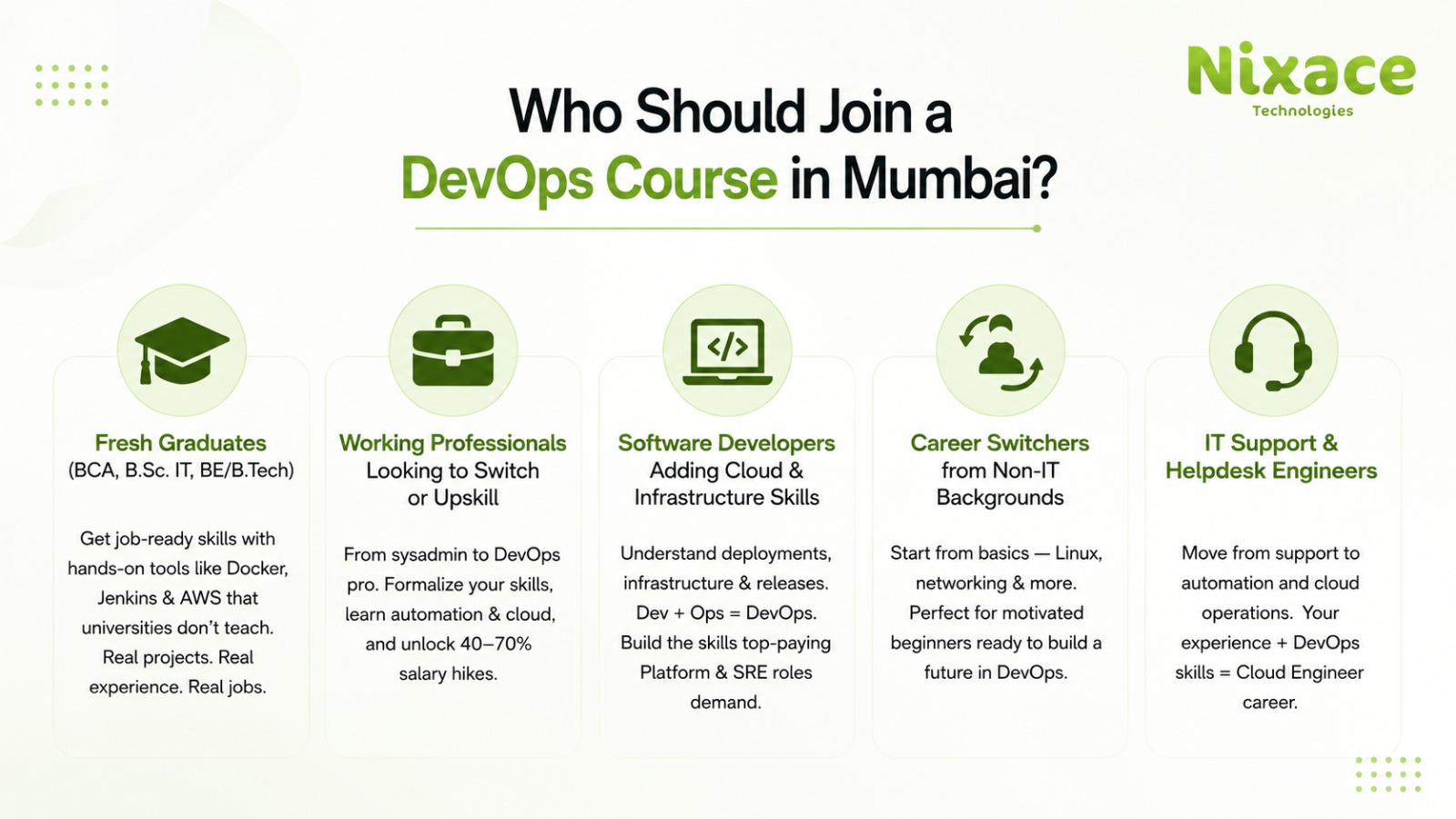
DevOps training attracts a wide range of learners. The course at Nixace Technologies is designed to serve five distinct profiles, each with a slightly different starting point and a different goal:
Fresh Graduates (BCA, B.Sc. IT, BE/B.Tech)
If you have graduated in a technology-related field but do not yet have industry experience, DevOps training gives you a practical skill set that is directly employable. Most entry-level DevOps roles in Mumbai's Western Suburbs look for hands-on experience with tools like Docker, Jenkins, and AWS that you cannot get from a university curriculum alone. A structured training program with real projects fills that gap.
Working Professionals Looking to Switch or Upskill
If you are currently working as a system administrator, Linux support engineer, network engineer, or manual tester, you already have foundational knowledge that translates well into DevOps. The training helps you formalize that knowledge, add automation and cloud skills, and position yourself for the 40–70% salary increase that typically comes with a lateral DevOps move in Mumbai.
Software Developers Adding Cloud and Infrastructure Skills
Full-stack and backend developers who want to understand deployment, infrastructure, and release engineering are strong DevOps candidates. Platform Engineering and SRE roles increasingly require this combination of development and operations knowledge — and they pay significantly more than standard developer roles.
Career Switchers from Non-IT Backgrounds
People transitioning from non-technical fields, sales, banking, and BPO operations, can enter DevOps if they are prepared to invest in foundational learning. The Nixace curriculum starts from Linux and networking fundamentals, making it accessible to motivated beginners who are willing to put in the work.
IT Support and Helpdesk Engineers
L1 and L2 support engineers who want to move into infrastructure automation and cloud operations find DevOps training a direct upgrade path. The operational mindset they already have is an asset; the training adds the automation and scripting layers that convert a support role into a cloud engineering role.
Quick Fit Check: You are a good fit for DevOps training if: you have basic comfort with computers, you are willing to practice daily (not just attend class), you have a genuine interest in how software gets built and deployed, and you are prepared to work on real projects rather than just pass an exam.
5. What Makes a Genuinely Good DevOps Institute?
Before committing to any DevOps course in Mumbai, apply a consistent evaluation framework. The market has many institutes offering certificates; very few deliver the practical capability that hiring managers actually test for.
Criterion 1: Instructor Experience
DevOps is a practitioner's discipline. Instructors who have designed CI/CD pipelines, managed production Kubernetes clusters, and debugged Terraform state files at actual companies teach differently from those who have only studied the documentation. Ask directly: where have the instructors worked, and what did they actually build?
Criterion 2: Real Project Work
The single question that exposes weak training programs is: 'Can you show me the projects students complete?' Legitimate programs have students deploy real applications on real cloud infrastructure. If a program cannot show you working project repositories, GitHub profiles, or cloud architecture diagrams from students, be cautious.
Criterion 3: Tool Coverage and Recency
The DevOps toolchain evolves. A program that still centers its curriculum around old-generation tools without covering Kubernetes, Terraform, and modern CI/CD practices is preparing you for a job market that has already moved on. Ensure the curriculum includes the tools listed in current Mumbai job postings.
Criterion 4: Batch Size
DevOps training requires hands-on time with instructors. Large batches of 30–50 students mean that individual questions go unanswered and lab time is constrained. Smaller batches of 10–20 students allow the kind of guided debugging and project feedback that actually develops skill.
Criterion 5: Placement Process Transparency
Be skeptical of institutes claiming '100% placement' without defining what that means. Does it mean a job in any role at any company, or does it mean a DevOps / cloud engineering role at a credible company? Ask for specifics: which companies, what roles, what starting packages, and what timeline?
6. Nixace Technologies: Complete DevOps Course Curriculum
The Nixace DevOps course is structured as a progressive curriculum that moves from fundamentals to production-grade practices. The program is designed so that each module builds on the previous one; you are not jumping between disconnected topics.
Module 1: Linux and Networking Foundations
Every DevOps engineer spends significant time in a Linux terminal. This module covers the essential Linux commands, file system structure, user and permission management, process management, shell scripting, and basic networking concepts that you will need every day on the job.
- Linux command line essentials — files, directories, permissions, processes
- Shell scripting for automation — loops, conditionals, functions, cron jobs
- Networking fundamentals — TCP/IP, DNS, HTTP, firewalls, SSH
- Linux package management and system administration basics
Module 2: Version Control with Git and GitHub
Version control is the foundation of every DevOps workflow. This module covers Git beyond the basics, branching strategies, pull request workflows, rebasing, and the GitFlow and trunk-based development models that professional teams use.
- Git init, add, commit, push, pull, merge, rebase
- GitHub / GitLab workflows: pull requests, code review, branch protection
- GitFlow and trunk-based development for team environments
Module 3: CI/CD with Jenkins and GitHub Actions
Continuous integration and continuous delivery are the heart of DevOps practice. Students build complete pipelines from scratch: automated builds, automated testing, code quality gates, Docker image builds, and deployments to cloud environments.
- Jenkins installation, configuration, and pipeline-as-code (Jenkinsfile)
- GitHub Actions workflows for automated testing and deployment
- Integrating SonarQube for code quality analysis
- Automated deployment pipelines targeting AWS EC2 and ECS
Module 4: Containerisation with Docker
Docker is the standard containerization technology in modern DevOps. This module goes beyond 'what is Docker' to building production-ready container images, managing multi-container applications with Docker Compose, and implementing container security best practices.
- Docker architecture, images, containers, and Dockerfile authoring
- Docker Compose for multi-service local development environments
- Private container registries: Docker Hub, AWS ECR, GitLab Registry
- Container security fundamentals: non-root users, image scanning
Module 5: Container Orchestration with Kubernetes
Kubernetes is the standard platform for running containerized applications at scale. Students in the Nixace program deploy full applications on Kubernetes clusters running on AWS EKS — not toy examples on a local Minikube setup.
- Kubernetes architecture — nodes, pods, deployments, services, ingress
- Kubernetes on AWS EKS — cluster setup, node groups, autoscaling
- Helm charts for application packaging and deployment
- Kubernetes storage — Persistent Volumes, ConfigMaps, Secrets
- Horizontal Pod Autoscaler and resource requests/limits
Module 6: Infrastructure as Code with Terraform
Terraform is the tool hiring managers most consistently ask about in DevOps interviews. Students learn to write Terraform configurations for real AWS infrastructure, manage remote state, and build reusable modules.
- Terraform providers, resources, variables, outputs, and data sources
- Remote state with AWS S3 and DynamoDB state locking
- Terraform modules — writing, calling, and versioning
- Terraform workspace strategy for multi-environment management
- Terraform in CI/CD pipelines — plan and apply automation
Module 7: Configuration Management with Ansible
While Terraform provisions infrastructure, Ansible configures it. Students use Ansible to automate software installation, configuration file management, and application deployment across multiple servers.
- Ansible inventory, playbooks, roles, and variables
- Idempotent configuration management for Linux servers
- Ansible integration with Terraform for post-provisioning configuration
Module 8: Cloud Platforms — AWS, Azure, GCP
The cloud is the environment in which all modern DevOps practices happen. The course provides practical experience on all three major cloud platforms with a primary focus on AWS.
- AWS: EC2, S3, VPC, IAM, RDS, ECS, EKS, Lambda, CloudWatch, Route 53
- Azure: Azure VMs, AKS, Azure DevOps, Azure Monitor
- GCP: GCE, GKE, Cloud Build, Cloud Monitoring
- Multi-cloud concepts and when to use each provider
Module 9: Monitoring, Logging, and Observability
Production systems need monitoring. Students deploy and configure a complete observability stack: metrics collection, dashboards, and alerting.
- Prometheus for metrics collection from applications and infrastructure
- Grafana for dashboards and alert management
- ELK Stack — Elasticsearch, Logstash, and Kibana for centralised logging
- Setting up alerts and on-call runbooks
Module 10: DevSecOps and Security Fundamentals
Security is no longer a separate phase; it is embedded into the DevOps pipeline. This module covers the practices that make DevOps pipelines secure without slowing down delivery.
- Container security scanning with Trivy and Clair
- Secret management — AWS Secrets Manager and HashiCorp Vault basics
- SAST integration into CI pipelines
- IAM best practices and least-privilege principle
7. Hands-On Projects and Cloud Labs
The difference between a course that looks impressive on paper and one that actually prepares you for interviews is projects. Interviewers at Mumbai's IT companies, whether at Mindspace or Andheri MIDC, routinely ask candidates to walk through something they have built. Classroom theory without build experience does not hold up in technical interviews.
The Nixace program includes the following capstone projects:
Project 1: End-to-End CI/CD Pipeline on AWS
Students build a complete CI/CD pipeline for a web application: code pushed to GitHub triggers an automated build in Jenkins, static analysis runs through SonarQube, a Docker image is built and pushed to AWS ECR, and the application is deployed to an ECS or EC2 target environment with a health check. Every step is automated; there are no manual deployment steps.
Project 2: Kubernetes Production Deployment
Students deploy a multi-tier application — web frontend, API backend, and PostgreSQL database — on an AWS EKS cluster. The deployment uses Helm charts, includes Horizontal Pod Autoscaling based on CPU metrics, stores database credentials in Kubernetes Secrets, and routes external traffic through an ALB Ingress controller.
Project 3: Infrastructure Automation with Terraform and Ansible
Students provision a complete three-tier AWS environment using Terraform: a VPC with public and private subnets, a NAT gateway, security groups, EC2 instances, and an RDS database. Ansible then configures the provisioned servers, installing the application, configuring systemd services, and setting up log forwarding to CloudWatch.
Project 4: Monitoring and Alerting Stack
Students deploy a Prometheus and Grafana monitoring stack for an application running on Kubernetes. They write custom Prometheus recording rules, build a multi-panel Grafana dashboard showing application latency, error rates, and resource utilization, and configure alerting rules that send notifications to a Slack channel.
Project 5: DevSecOps Pipeline Integration
Students integrate security scanning into an existing CI/CD pipeline: Trivy scans Docker images for CVEs before pushing to ECR; tfsec scans Terraform configurations for misconfigurations, and SAST analysis runs on every pull request. Students experience how to handle scan results and define policies for blocking vs. warning findings.
Cloud Lab Access: All Nixace students receive cloud lab access for the duration of the program. Labs run on real AWS accounts, not simulators. This means the EKS clusters, EC2 instances, and S3 buckets you work with are genuine cloud resources, and the experience is directly comparable to what you will encounter at an employer.
8. Tools and Technologies You Will Master
Table 2: DevOps tools covered in the Nixace Technologies program
| Category | Tools Covered | Why They Matter |
|---|---|---|
| Operating System | Linux (Ubuntu, CentOS) | Every cloud server runs Linux; this is non-negotiable |
| Version Control | Git, GitHub, GitLab | Foundation of collaborative engineering and CI/CD |
| CI/CD | Jenkins, GitHub Actions, GitLab CI | Core pipeline tools asked about in 90% of DevOps interviews |
| Containers | Docker, Docker Compose | Standard packaging for modern applications |
| Orchestration | Kubernetes (EKS, AKS, GKE), Helm | Production container management at scale |
| Infrastructure as Code | Terraform, Ansible | Provisioning and configuration automation |
| Cloud | AWS (primary), Azure, GCP | Where the actual jobs are |
| Monitoring | Prometheus, Grafana, ELK Stack | Production observability expected in senior interviews |
| Security | Trivy, tfsec, AWS Secrets Manager | DevSecOps is increasingly required in Mumbai job market |
| Scripting | Bash, Python basics | Automation requires the ability to script |
9. DevOps Certifications: What to Earn and When
Certifications in DevOps serve a specific purpose: they validate your knowledge to recruiters who may not have time to deeply evaluate every candidate's technical depth. They are not a substitute for hands-on experience, but combined with project work, they significantly strengthen your resume.
Table 3: Recommended DevOps certifications and timing
| Certification | Provider | Difficulty | When to Target |
|---|---|---|---|
| AWS Certified Cloud Practitioner | Amazon Web Services | Beginner | During or after cloud module |
| AWS Certified Solutions Architect – Associate | Amazon Web Services | Intermediate | After completing the program |
| Certified Kubernetes Administrator (CKA) | CNCF / Linux Foundation | Advanced | After 3–6 months of Kubernetes experience |
| HashiCorp Certified: Terraform Associate | HashiCorp | Intermediate | After completing IaC module |
| AWS Certified DevOps Engineer – Professional | Amazon Web Services | Advanced | 12–18 months post-employment |
The Nixace program prepares students for the AWS Cloud Practitioner and Solutions Architect Associate exams as part of the curriculum. CKA preparation is integrated into the Kubernetes module. Exam vouchers and additional mock test sessions are provided as part of the enrollment package.
10. Placement Assistance and Career Support at Nixace
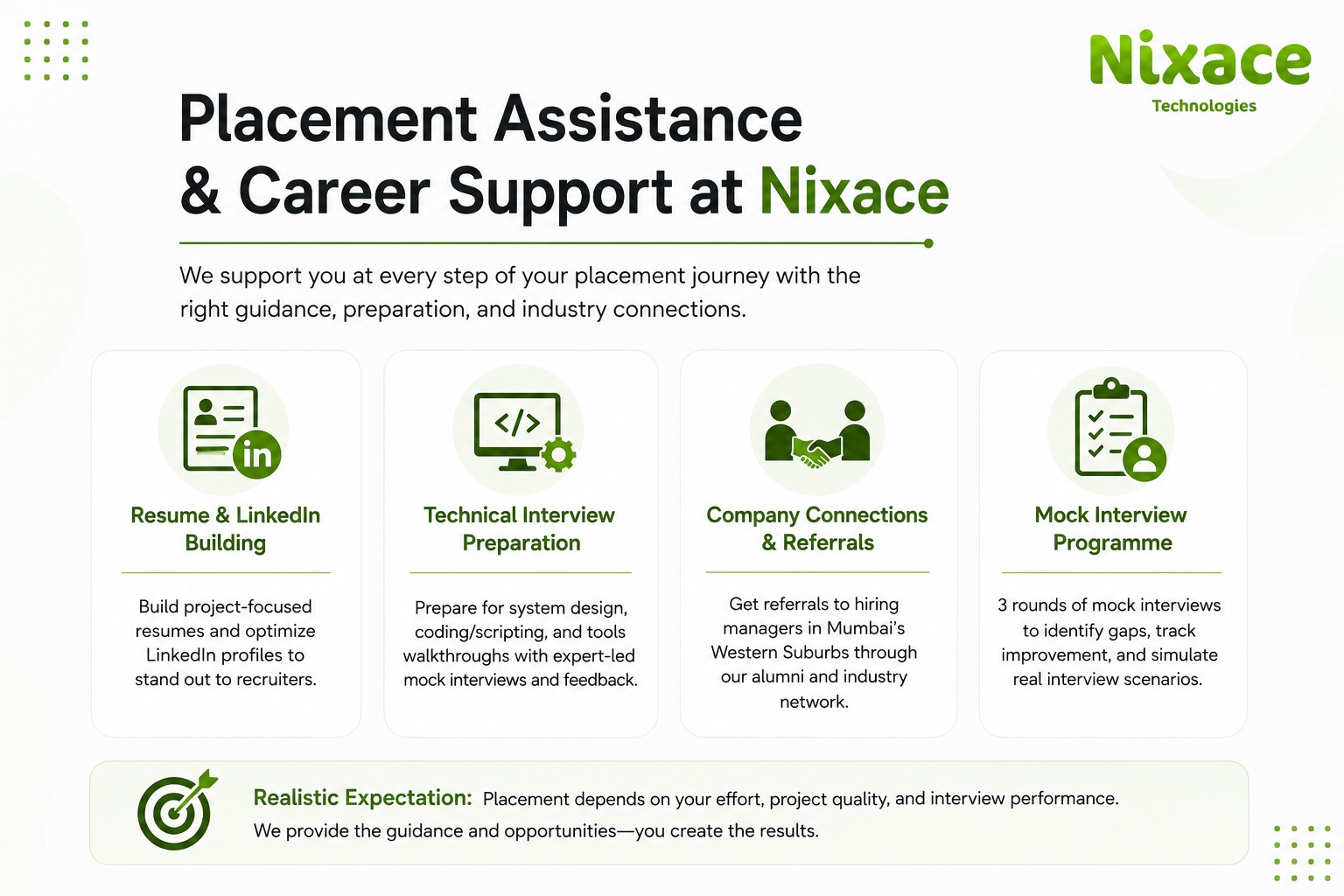
Placement support at Nixace is a structured process, not a promise that we will hand you a job after you attend class. Getting placed requires that you develop genuine skills, build a portfolio, and engage seriously with interview preparation. Our role is to facilitate every step of that process.
Resume and LinkedIn Profile Building
A DevOps resume needs to lead with projects and tool experience, not just a list of modules attended. The Nixace placement team works with each student to document their project work, quantify outcomes where possible, and structure the resume for the Mumbai IT job market. LinkedIn profiles are reviewed with the same rigor because many Mumbai-based recruiters source candidates directly from LinkedIn.
Technical Interview Preparation
DevOps technical interviews in Mumbai typically involve three components: a system design discussion, a live coding or scripting task, and a tools walkthrough where you explain something you have built. Nixace runs structured mock interview sessions that simulate all three components, with feedback from instructors who have been on the hiring side.
Company Connections and Job Referrals
Through alumni and industry connections, Nixace provides referrals to hiring managers at companies in the Goregaon, Malad, and Andheri corridors. These referrals do not guarantee placement; your performance in the interview does, but they ensure that your resume reaches a human reviewer rather than disappearing into an application tracking system.
Mock Interview Programme
Students go through at least three rounds of mock technical interviews before being recommended for external interviews. The first round identifies knowledge gaps. The second round assesses improvement. The third round simulates a final-round interview under realistic conditions.
Realistic Expectation: Placement depends on your consistent effort throughout the program, the quality of your project work, and your interview performance. DevOps is a high-demand field, and Mumbai's Western Suburbs corridor has strong hiring, but no training institute can guarantee outcomes that depend on your individual effort and the timing of your job search.
11. DevOps Career Paths and Salary in Mumbai
DevOps is not a single job title; it is a cluster of related engineering roles that share an emphasis on automation, collaboration, and continuous delivery. Understanding the career landscape helps you target the right roles at the right stage of your career.
Table 4: DevOps career levels and salary ranges in Mumbai (July 2025 estimates, will vary by company and experience)
| Role | Experience Required | Salary Range (Mumbai) | Primary Tools |
|---|---|---|---|
| Junior DevOps Engineer | 0–1 year | ₹4–7 LPA | Linux, Git, Jenkins, Docker |
| DevOps Engineer | 1–3 years | ₹7–14 LPA | Kubernetes, Terraform, AWS |
| Senior DevOps Engineer | 3–6 years | ₹14–22 LPA | Multi-cloud, Ansible, GitOps |
| Site Reliability Engineer (SRE) | 3–7 years | ₹16–28 LPA | SLO/SLI, Prometheus, On-call management |
| Platform Engineer | 4–8 years | ₹18–30 LPA | Kubernetes, Backstage, Platform design |
| Cloud Architect | 7+ years | ₹25–45 LPA | Multi-cloud, IaC, Architecture design |
Salary ranges above are based on current job postings and alumni data in the Mumbai market. Entry-level packages for freshers completing comprehensive DevOps training typically fall between ₹4–7 LPA in the Western Suburbs corridor. Professionals switching from adjacent IT roles (sysadmin, support) with 2–3 years of experience often enter at ₹7–10 LPA. These are estimates; individual outcomes depend on interview performance, company type, and the specific tools the employer prioritizes.
Career Progression Timeline
- Month 1–6: Training, project portfolio building, first certifications
- Month 6–9: Job search, mock interviews, first offers at ₹4–7 LPA
- Years 1–2: Build Kubernetes and AWS production experience in employment
- Year 2–4: Specialise in SRE, Platform Engineering, or cloud architecture.
- Year 4+: Senior/lead roles at ₹18–30+ LPA or move into consulting
12. Frequently Asked Questions
What is the duration of the DevOps course at Nixace Technologies?
The comprehensive DevOps course runs for approximately 4–5 months for weekday batches and 5–6 months for weekend batches. The weekend option is designed for working professionals who cannot attend weekday classes and covers the same curriculum with Sunday sessions plus recorded access for revision.
Do I need coding experience to join the DevOps course?
You do not need advanced programming experience, but comfort with basic computer usage and a willingness to learn scripting is important. The curriculum starts from Linux fundamentals and introduces Bash scripting and Python basics early. If you can use a computer for work and are willing to practice typing commands in a terminal, you can learn what the course teaches.
What is the course fee for DevOps training in Goregaon?
Nixace Technologies maintains transparent fee structures shared during counseling sessions. Fees vary based on batch type (weekday vs. weekend) and enrollment timing. Contact the Nixace team directly for current fee details, installment options, and any early-enrollment pricing.
What separates Nixace from other DevOps coaching institutes in Mumbai?
Three things: the Goregaon West location within the Western Suburbs IT corridor (close to Mindspace and the Andheri-MIDC cluster), the project-first curriculum where you build real applications on real AWS infrastructure, and batch sizes capped to ensure instructor attention. The trainers are practicing DevOps engineers, not instructors who only teach.
Can I attend a demo class before enrolling?
Yes. Nixace offers introductory demo sessions where you can experience the teaching style, see the lab environment, and ask questions before committing. Visit nixacetech.com or call the team to schedule a demo for the next available batch.
Is the DevOps course available offline in Goregaon West?
Yes. The primary mode of delivery is classroom-based, offline training in Goregaon West, Mumbai. This is intentional. DevOps is a hands-on discipline that benefits from real-time interaction, collaborative lab sessions, and direct access to an instructor when you are debugging a Kubernetes deployment or a Terraform error. Online-only courses struggle to replicate this.
What AWS services are covered in the DevOps course?
The Nixace program covers the AWS services that appear most frequently in DevOps job requirements: EC2, S3, VPC, IAM, RDS, ECS, EKS, Lambda, CloudWatch, CloudTrail, Route 53, and AWS Secrets Manager. The curriculum aligns with the AWS Certified Solutions Architect Associate and AWS Certified DevOps Engineer Professional exam objectives.
How does Nixace prepare students for DevOps interviews?
Through a three-round mock interview program run by experienced instructors, structured resume reviews, GitHub portfolio building, and LinkedIn profile optimization. Students also receive interview question banks specific to the Mumbai market and the DevOps roles advertised by companies in Andheri, Goregaon, and Malad.
What certifications does the course prepare me for?
The program prepares you for the AWS Cloud Practitioner, AWS Solutions Architect Associate, HashiCorp Terraform Associate, and Certified Kubernetes Administrator (CKA) certifications. Exam preparation is integrated into the curriculum rather than treated as a separate add-on.
Is there a community or alumni network after the course?
Nixace maintains a WhatsApp group and LinkedIn community of alumni where job referrals, interview experiences, and tool tips are shared actively. Being part of the local Western Suburbs DevOps community is one of the less-publicized but genuinely valuable benefits of studying at a Mumbai-based institute rather than an online platform.
What DevOps tools are most in demand in Mumbai right now?
Based on current job postings in the Western Suburbs corridor, the most requested tools are Kubernetes (and specifically AWS EKS), Docker, Terraform, Jenkins or GitHub Actions, and AWS core services. Python scripting and monitoring with Prometheus/Grafana appear frequently in job descriptions for mid-level and senior roles.
Can working professionals join evening or weekend batches?
Yes. Nixace runs weekend batches specifically for working professionals who cannot commit to weekday classes. Weekend sessions run on Sundays with recordings available for revision. The same curriculum and project requirements apply; only the schedule differs.
13. Conclusion: Your DevOps Career Starts in Western Mumbai
Mumbai's western suburbs are one of the best places in India to build a DevOps career. The IT companies are here. The jobs are here. And with the right training, the technical skills to land those jobs are accessible to anyone willing to invest the time.
The key is choosing a training program that values hands-on practice over certificate collection, instructor expertise over brand name, and honest career guidance over exaggerated placement claims. DevOps is a skills game; the engineers who get hired are the ones who can demonstrate what they have built, not just recite theory.
Nixace Technologies in Goregaon West is built around that philosophy. If you are ready to invest 4–6 months of genuine effort coming to class, completing the lab work, and building the project portfolio, the Western Suburbs IT corridor has the jobs waiting on the other side.
Related reading: DevOps Training in Goregaon, DevOps Training in Andheri, and DevOps Training Institute in Mumbai.