
NIXACE TECHNOLOGIES
Key Takeaways
- AI is no longer a bolt-on. AIOps and AI-assisted CI/CD are becoming default behavior in pipelines, not experimental features.
- Platform Engineering and Internal Developer Platforms (IDPs) are absorbing many traditional DevOps responsibilities, especially at mid-size and large companies.
- Security has moved fully left: DevSecOps, SBOMs, and software supply chain security are now baseline hiring requirements, not specializations.
- FinOps and cloud cost optimization skills are increasingly expected of DevOps engineers, not just finance teams.
- For students and career switchers, the highest-leverage skills to learn in 2026 are Kubernetes, Terraform, GitOps (Argo CD), one cloud platform, and basic AIOps tooling in that order.
- This guide includes a free 90-day DevOps learning roadmap and a job-readiness checklist you can use immediately.
1. What Are the Trends for DevOps in 2026?
If you've been asking what are the trends for DevOps in 2026, the honest answer is this: DevOps in 2026 looks less like a toolchain and more like an operating model built around AI, self-service platforms, and security baked in from day one. The gap between "DevOps engineer" and "platform engineer" is shrinking, and the bar for entry-level roles has quietly gone up.
This matters most if you're a student or career switcher trying to break into the field, because the skills that got someone hired in 2022 (basic CI/CD scripting, a bit of Docker) are no longer enough on their own. Below, we break down the 10 trends actually shaping hiring, tooling, and team structures in 2026, and, unlike most trend round-ups written for CTOs, we translate every trend into what it means for your learning plan and your resume.
This guide is written for students studying DevOps/cloud computing, career switchers moving into tech from other fields, and junior engineers who want to understand where to focus their learning in 2026.
2. AI-Powered DevOps (AIOps) Becomes the Default, Not the Differentiator
AIOps, the application of AI and machine learning to IT operations, has moved from "nice to have" to expected baseline in most mid-size and enterprise DevOps teams. Instead of engineers manually correlating logs, metrics, and traces during an incident, AIOps platforms now surface probable root causes automatically and, increasingly, suggest or trigger the fix.
Why does it matter?
Teams running dozens of microservices can no longer rely on humans to spot anomalies across thousands of metrics. AIOps tools compress mean time to detection (MTTD) and mean time to resolution (MTTR), which are now common performance metrics for DevOps and SRE teams.
What does this look like in practice?
- AI-assisted code review bots flagging issues before a pull request merges.
- Predictive monitoring that flags a disk-usage trend days before it becomes an outage.
Common mistake: teams add an AI monitoring tool without fixing their underlying observability data first. Clean telemetry always comes before AI.
For students & career switchers
You don't need to build AI models. You need to be comfortable working alongside AIOps tools, reading their output critically, understanding what data feeds them, and knowing when to trust an automated recommendation versus escalating to a human. Familiarity with at least one observability platform (Datadog, New Relic, or the open-source Prometheus + Grafana stack) is now a practical entry point.
3. Platform Engineering and Internal Developer Platforms (IDPs) Take Over Core DevOps Work
Platform engineering, building self-service "golden path" infrastructure that developers can consume without needing DevOps help for every request, is one of the clearest structural shifts of 2026. Instead of a DevOps engineer manually provisioning a new environment on request, developers use an internal developer platform (via tools like Backstage, Port, or Humanitec) to spin one up themselves.
Why does it matter?
This reduces ticket queues and lets DevOps/platform teams focus on building reusable infrastructure templates rather than one-off requests. It's also changing job titles: many roles once labeled "DevOps Engineer" are being re-posted as "Platform Engineer."
Step-by-step guide on how a golden path works
- A developer requests a service from the internal developer portal.
- The IDP provisions infrastructure using pre-approved templates (Terraform and Helm).
- Security and compliance policies apply automatically, not through manual review.
- The developer gets a working environment in minutes instead of days.
For students & career switchers
Learn Backstage basics and understand Infrastructure as Code (IaC) with Terraform. Employers increasingly want to see that you understand self-service infrastructure concepts, even at a junior level, because platform engineering literacy is quickly becoming assumed knowledge rather than a specialization.
4. DevSecOps by Default: Security Is No Longer a Separate Step
DevSecOps has stopped being a trend and become a baseline expectation. Security scanning, secrets management, and compliance checks are now built directly into CI/CD pipelines rather than handled by a separate security team after deployment.
Why does it matter?
Software supply chain attacks (compromised dependencies and poisoned container images) have made "shift-left" security non-negotiable for regulated industries like finance and healthcare and increasingly for everyone else too.
Common mistakes teams make
- Adding a security scanner but muting its alerts because they slow down releases.
- Treating a Software Bill of Materials (SBOM) as a checkbox instead of a monitored asset.
For students & career switchers
Get hands-on with at least one static application security testing (SAST) tool (like Semgrep or SonarQube) and understand what an SBOM is and why it exists. You don't need to become a security engineer; you need to show you can work inside a security-integrated pipeline without being told twice.
5. GitOps Expands Beyond Kubernetes
GitOps, using Git as the single source of truth for infrastructure and deployments, has historically been tied to Kubernetes via tools like Argo CD and Flux. In 2026, GitOps principles are expanding into broader infrastructure management, including multi-cloud orchestration and even serverless deployments.
Why does it matter?
Every change lives in a pull request, which means every infrastructure change is reviewable, auditable, and revertible. This dramatically reduces "who changed what in production" incidents.
For students & career switchers
Argo CD is one of the highest ROI tools you can learn right now. It's widely used and well-documented and a strong signal on a resume or in an interview that you understand modern deployment patterns, not just running “kubectl commands” manually.
6. FinOps and Cloud Cost Optimization Become a Core DevOps Skill
As cloud bills have grown, FinOps, the discipline of managing and optimizing cloud spend has moved from a finance-team concern to a shared responsibility with DevOps and platform teams. Kubernetes cost visibility tools (Kubecost, OpenCost) are now commonly part of the DevOps toolchain.
Why does it matter?
Engineering decisions (over-provisioned instances, idle environments, unoptimized autoscaling) directly drive cloud costs. Companies increasingly want DevOps hires who can talk about cost, not just uptime.
For students & career switchers
Learn to read a cloud cost report and understand basics like right-sizing instances, spot instances, and autoscaling policies. Even a surface-level understanding of FinOps terminology sets you apart from candidates who only talk about uptime and deployment speed.
7. Observability Evolves Into Predictive Reliability
Observability is shifting from "can we see what's happening" to "can we predict what's about to happen." OpenTelemetry has become the dominant standard for unifying logs, metrics, and traces across tools, replacing a lot of the fragmented, vendor-specific instrumentation of previous years.
Why it matters
Unified telemetry data is also what feeds AIOps tools (see Trend #2); without solid observability, predictive alerting simply doesn't work well.
For students & career switchers
Learn OpenTelemetry basics and get comfortable with at least one dashboarding tool (Grafana is free and widely used). Being able to explain the difference between logs, metrics, and traces in an interview is a surprisingly strong differentiator for junior candidates.
8. Site Reliability Engineering (SRE) Principles Become Mainstream
SRE concepts, Service Level Objectives (SLOs), error budgets, and blameless postmortems are increasingly adopted by teams that don't have a formal SRE department. The line between "DevOps engineer" and "SRE" is blurring at small and mid-size companies.
For students & career switchers
You should be able to explain SLI, SLO, and SLA in plain language and describe what an error budget is used for. This vocabulary comes up often in interviews, even for junior roles.
9. Kubernetes and Cloud-Native Platforms Continue to Lead Modern Infrastructure
Despite predictions of Kubernetes being "too complex" and getting replaced, it remains the dominant orchestration layer for cloud-native applications in 2026. What's changing is how teams interact with it, often through the abstraction layers described in Trend #3 (platform engineering), rather than raw kubectl commands.
For students & career switchers
Kubernetes remains the single highest-value technical skill for a DevOps career in 2026. Start with core objects (pods, deployments, services, ingress), then move to Helm for packaging and Argo CD for GitOps-style deployment.
10. Software Supply Chain Security Becomes Non-Negotiable
High-profile dependency and container-image compromises have pushed supply chain security into standard practice. SBOMs, image signing (via tools like Cosign/Sigstore), and dependency scanning are increasingly required, not optional, especially for teams shipping to regulated industries.
For students & career switchers
Understand what an SBOM contains and why container image provenance matters. You don't need deep security expertise, but you should be able to explain why "we don't know what's inside our container images" is a real business risk.
11. Autonomous and AI-Assisted CI/CD Pipelines Become Reality
CI/CD pipelines in 2026 increasingly use AI to auto-detect flaky tests, auto-heal known failure patterns, and recommend (or automatically apply) rollback decisions when a deployment shows early signs of trouble without waiting for a human to notice a dashboard spike.
For students & career switchers
Learn one CI/CD platform deeply (GitHub Actions or Jenkins are both common) before worrying about AI add-ons. AI-assisted pipeline features are built on top of solid CI/CD fundamentals; you can't skip the fundamentals.
DevOps in 2022 vs. DevOps in 2026: What Actually Changed
It's easy to feel like every year brings a completely new set of tools. In reality, the shift is more about who does the work and how proactive it is. Here's a side-by-side comparison:
| Area | DevOps in 2022 | DevOps in 2026 |
|---|---|---|
| Infrastructure requests | Manual tickets to DevOps team | Self-service via internal developer platform |
| Security | Separate review after deployment | Integrated into CI/CD from day one (DevSecOps) |
| Monitoring | Reactive dashboards, manual triage | Predictive AIOps with automated root-cause analysis |
| Cost management | Handled mostly by finance/ops leadership | Shared responsibility with FinOps practices |
| Deployments | Scripted CI/CD, manual approvals | GitOps-driven, auditable, often auto-rollback |
| Job titles | DevOps Engineer | Platform Engineer / DevOps Engineer / SRE (overlapping) |
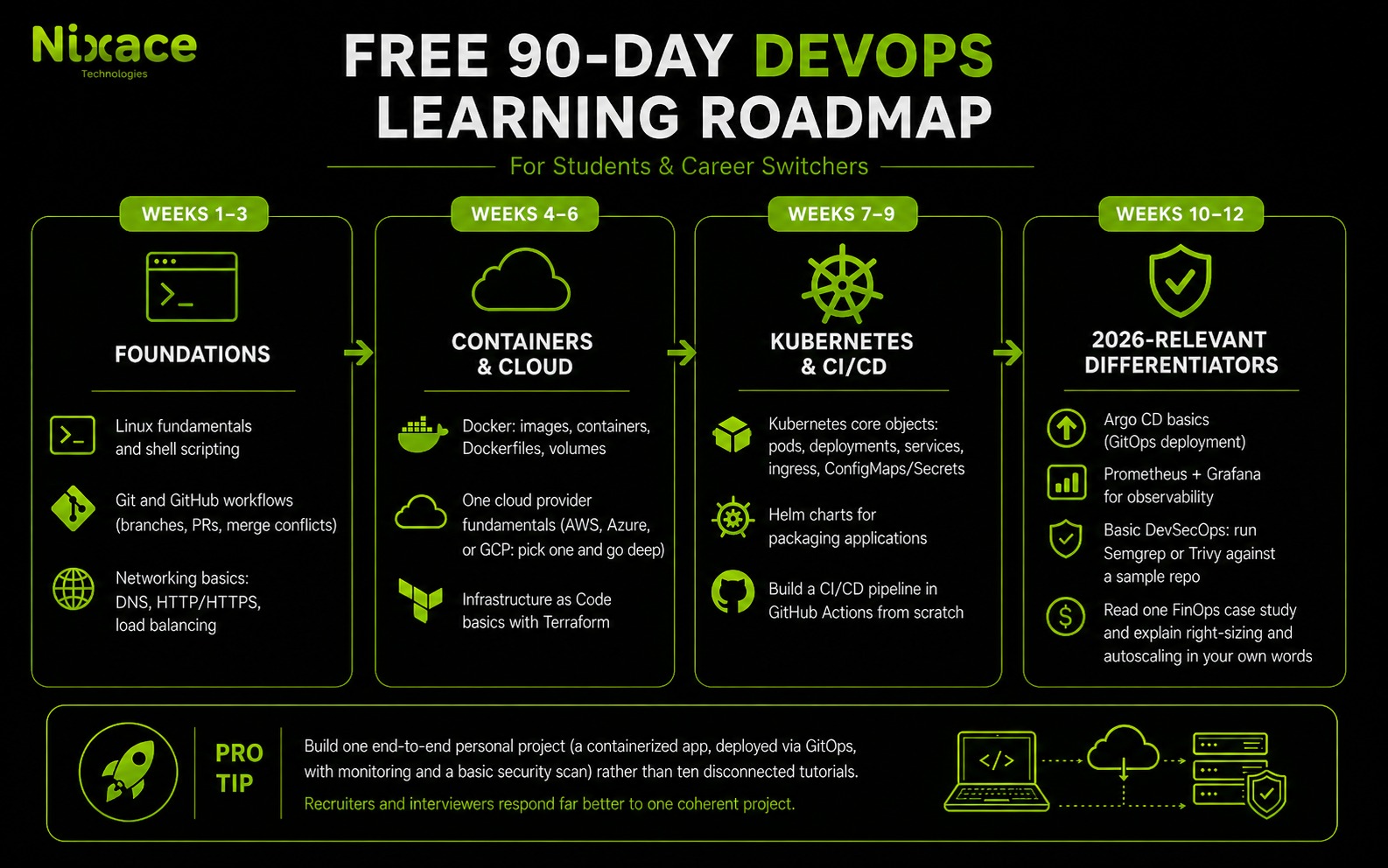
Free 90-Day DevOps Learning Roadmap for Students and Career Switchers
Most 2026 trend articles are written for CTOs deciding where to invest. If you're trying to get your first DevOps job, here's a practical, sequenced roadmap based on the trends above focused on what's actually asked about in interviews.
Weeks 1–3: Foundations
- Linux fundamentals and shell scripting
- Git and GitHub workflows (branches, PRs, merge conflicts)
- Networking basics: DNS, HTTP/HTTPS, load balancing
Weeks 4–6: Containers and Cloud
- Docker: images, containers, Dockerfiles, volumes
- One cloud provider fundamentals (AWS, Azure, or GCP; pick one and go deep)
- Infrastructure as Code basics with Terraform
Weeks 7–9: Kubernetes and CI/CD
- Kubernetes core objects: pods, deployments, services, ingress, ConfigMaps/Secrets
- Helm charts for packaging applications
- Build a CI/CD pipeline in GitHub Actions from scratch
Weeks 10–12: 2026-Relevant Differentiators
- Argo CD basics (GitOps deployment)
- Prometheus + Grafana for observability
- Basic DevSecOps: run Semgrep or Trivy against a sample repo
- Read one FinOps case study and be able to explain right-sizing and autoscaling in your own words
Pro tip: Build one end-to-end personal project (a containerized app, deployed via GitOps, with monitoring and a basic security scan) rather than ten disconnected tutorials. Recruiters and interviewers respond far better to one coherent project than a long list of course completions.
Job-Readiness Checklist
- ☐ I can explain the difference between DevOps, Platform Engineering, and SRE
- ☐ I have deployed at least one containerized application to a cloud environment
- ☐ I can write a basic Terraform module from scratch
- ☐ I understand what a CI/CD pipeline does at each stage
- ☐ I have a GitHub profile with at least one well-documented DevOps project
Honest Limitations: What These Trends Don't Solve
It's worth being direct about the limits of chasing trends alone:
- AIOps tools reduce noise but still require engineers who understand the underlying systems.
- Platform engineering works best at organizations with enough scale to justify building one; smaller teams may not need it yet.
- For entry-level candidates, employers still weight fundamentals like Linux, networking, Git, and one cloud platform more than familiarity with the newest tools.
Where Nixace Technologies Fits In
At Nixace Technologies, we work with organizations implementing the trends covered in this guide, from platform engineering builds to DevSecOps pipeline integration. If you're a learner who wants mentorship from engineers working on these systems day to day, our team is happy to talk through your situation, no sales pitch, just a conversation about what makes sense for where you are.
Frequently Asked Questions
1. What are the trends for DevOps in 2026?
The leading trends are AI-powered DevOps (AIOps), platform engineering and internal developer platforms, DevSecOps by default, GitOps expansion, FinOps, predictive observability, SRE adoption, continued Kubernetes dominance, software supply chain security, and AI-assisted CI/CD pipelines.
2. Is DevOps still in demand in 2026?
Yes. DevOps remains in high demand, though job titles are diversifying into platform engineer, SRE, and DevSecOps engineer roles that share core DevOps skills. Entry-level hiring increasingly expects familiarity with Kubernetes and IaC.
3. Is platform engineering replacing DevOps?
Not entirely — it's better understood as an evolution of DevOps practices focused on self-service infrastructure. Core DevOps skills like CI/CD, IaC, and containers remain foundational to platform engineering roles.
4. Do I need to learn AI to work in DevOps in 2026?
You don't need to build AI models, but you do need to be comfortable working with AI-powered tools interpreting their recommendations and knowing when to override an automated decision.
5. Is Kubernetes still worth learning in 2026?
Yes. Kubernetes remains the dominant container orchestration platform. Even as platform engineering abstracts some direct interaction, understanding its core concepts is still a highly valued skill.
6. What is the difference between DevOps and DevSecOps?
DevOps focuses on collaboration and automation between development and operations teams. DevSecOps extends this by embedding security scanning and compliance checks directly into the CI/CD pipeline from the start.
7. How long does it take to learn DevOps as a career switcher?
With consistent effort, most career switchers reach a job-ready foundational level in three to six months, covering Linux, Git, one cloud platform, containers, CI/CD, and basic Kubernetes.
8. What certifications are valuable for DevOps in 2026?
Associate-level cloud certifications (AWS, Azure, or GCP), the Certified Kubernetes Administrator (CKA), and Terraform Associate are among the most recognized by employers.
Conclusion: Turning DevOps Trends Into a Career Plan
The trends for DevOps in 2026 point toward one clear direction: more automation, more security built in from the start, and more self-service infrastructure with human engineers focused on judgment calls AI can't make yet. For students and career switchers, the winning strategy isn't chasing every new tool mentioned in a trends article. It's building solid fundamentals in Linux, one cloud platform, containers, and CI/CD, then layering in the 2026-specific differentiators covered here: GitOps, basic DevSecOps practices, and observability.
If you're building your own learning plan around these trends, start with the 90-day roadmap above, complete one full end-to-end project, and revisit the job-readiness checklist before applying. And if you want a second opinion on your learning path or a company's DevOps transformation plan, Nixace Technologies is happy to talk it through.